


If you want to argue that curling is a sport invented by and for wizards, no one could easily dismiss the claim.
The deep origins of curling are both unknown and unknowable.
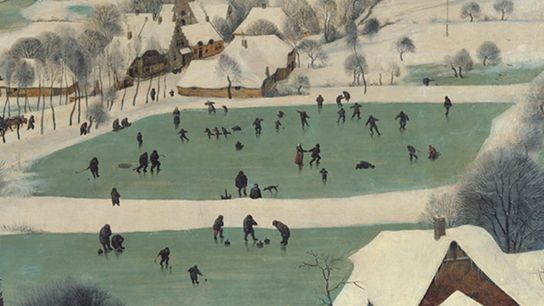
Officially, the rules of the game were first codified in Scotland in the early 19th Century, but the oldest club traces its beginnings to 1668. Curling (or something very much like it) is depicted in Pieter Bruegel the Elder’s masterwork, “The Hunters in the Snow,” dated 1565. The oldest known curling stone was discovered in a Scottish bog, inscribed with the year 1511. The earliest written reference to eisstock, a related proto-version of curling, dates to 1192.
null
A sliver of Peter Bruegel's "The Hunters in the Snow," 1565.
We simply have no idea how long curling and its antecedents have existed, but we can confidently say that people have been propelling smooth stones on frozen bodies of water for many centuries. It’s possible that for as long as humans have lived together cooperatively in cold places, there has been curling.
The opening ceremonies of the Milan-Cortina Winter Olympics will take place on Friday, February 6, but mixed doubles curling is already underway. If you enjoy freakish technique and precision — and charming interactions — we cannot recommend it highly enough. The tension in this sport is something you will feel in your teeth and bones. The physics involved seem magical. It's mesmerizing.
Another look at the Niklas Edin spinner! This man is not human! pic.twitter.com/VHyndu13bv
— Grand Slam of Curling (@grandslamcurl) January 10, 2026
Delightfully, every curling stone in use at the Olympics (and in most other high-level competitions) is made from granite found on Ailsa Craig, a tiny, uninhabited volcanic island located several miles off Scotland’s southwest coast. At various points in the recorded history of this pyramid-shaped rock, it has been a sanctuary for pirates, religious dissenters and hermits. It is presently populated only by puffins, gannets and other seabirds. The peculiar microgranite found on Ailsa Craig is uniquely resistant to moisture and fractures, and can only be found in large quantities on this one inhospitable island.
Basically, everything about curling feels like fantasy fiction, including the stones themselves. How can you not love this sport — even if you’re only reminded to love it for a week or two every four years?
Curling is weird and ancient and perfect, and it will outlast us all. It is once again time to relearn rules and develop fierce allegiances to individual participants. Please give curling your full attention, urgently.